
The Emotional Cost of Belonging at Work

The professional space is often described as demanding, but rarely do we interrogate what it truly demands of us. It is not the workload alone that exhausts people. It is the performance of character. It is the daily emotional choreography of knowing when to speak and when to stay silent, when to soften and when to assert, when to connect and when to withdraw. In many South African workplaces, survival is not just about competence, but about emotional navigation. It is not the job that breaks people, but the constant requirement to adjust who they are in order to fit where they are.
A talkative person must learn silence. A shy person must learn to perform. A person who struggles with mornings must master punctuality. A person who enjoys humour must measure every joke. A person who naturally affirms others must filter every compliment. Even kindness becomes a risk. Even warmth becomes a liability. One must think before speaking, calculate before reacting, and weigh every gesture against possible interpretation. You show up at work not just with your skills, but with a version of yourself that is carefully curated for safety, acceptance and survival. It takes emotional energy just to exist in professional spaces, long before the actual work begins.
This reality exists within a country where work itself is already a privilege. According to Statistics South Africa, unemployment remains structurally high, with youth unemployment consistently exceeding 40 percent. In such an environment, employment becomes more than income. It becomes identity, stability, dignity and survival. People do not only fear losing their jobs, they fear losing their place in society. That fear intensifies the emotional pressure to perform professionalism correctly, to avoid conflict, to avoid missteps, and to avoid labels that could follow a person across industries and careers.
Yet emotional intelligence is not formally taught in most South African schools. We learn mathematics, science, history and language, but not how to manage perception, boundaries, emotional regulation or professional relationships. We enter workplaces emotionally untrained for the complexity we encounter. We navigate blindly, learning through mistakes, misunderstandings and consequences. One wrong sentence, one misinterpreted gesture, one poorly timed joke, and suddenly a reputation is formed. Labels emerge quietly but stick loudly. You are too friendly. You are too cold. You are too soft. You are too aggressive. In a professional world driven by perception, identity becomes something others define before you do.
South Africa’s diverse cultural landscape further complicates this terrain. Communication styles differ across cultures, communities and social backgrounds. What is considered respectful in one space may be interpreted as distant in another. What is considered warmth in one environment may be seen as inappropriate in another. These differences require sensitivity, yet most workplaces do not provide structured support for navigating them. People are expected to “just know” how to behave, even when no one has taught them how.
The result is emotional tension. People become hyper aware of themselves. They monitor their tone, posture, language and expressions. They dilute their personalities to fit corporate norms. They suppress parts of who they are to appear neutral, safe and acceptable. Over time, this creates emotional fatigue. The self that goes to work becomes disconnected from the self that exists at home. Professionalism becomes performance rather than integrity.
At the same time, workplaces demand humanity. Collaboration requires warmth. Teamwork requires trust. Leadership requires empathy. Yet boundaries must be maintained. Professional distance must be preserved. The contradiction is constant. Be human, but not too human. Be friendly, but not familiar. Be approachable, but not vulnerable. Be confident, but not intimidating. These contradictions create a narrow emotional corridor that employees must walk daily without guidance or maps.
So the modern South African worker stands at a difficult intersection. They must be legally safe, socially safe, emotionally safe and professionally competent at the same time. They must collaborate without becoming personal. They must build relationships without crossing boundaries. They must show respect without showing weakness. They must be approachable without being vulnerable. They must lead without dominating and follow without disappearing. This is not simple emotional labour. It is constant identity negotiation.
Yet humanity cannot be removed from work without cost. When people become too guarded, workplaces become cold. When people become too rigid, collaboration suffers. When people suppress their humanity, morale declines. Burnout is not only caused by workload. It is caused by emotional suppression, identity fragmentation and constant self monitoring. The future of work in South Africa will not only be defined by technology, skills and productivity. It will be defined by emotional intelligence, by how safely people can show up as themselves, and by how organisations balance policy with personhood. Because in the end, work is not only about what we do. It is about who we become while doing it.
—————————–
About the Author:
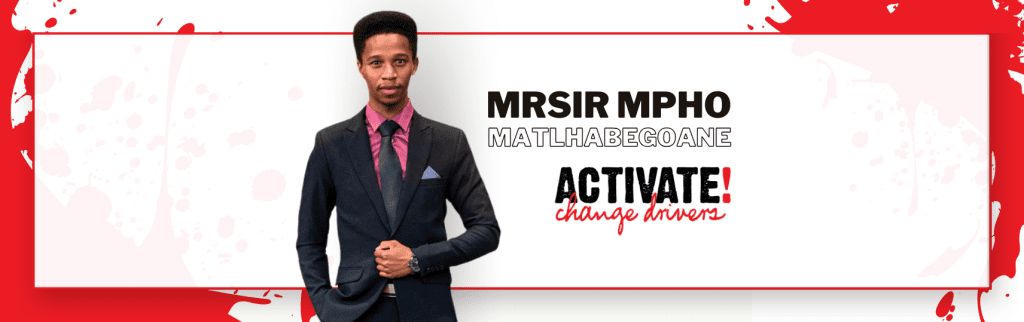
Mpho (MrSir) Matlhabegoane is a member of the ACTIVATE! Change Drivers Writers Hub. He became an Activator in 2019. He is a Mental Health Awareness Advocate, and to spread mental health awareness, he authored and published three books that are accepted by Gauteng Department of Education as of 2026, namely: The Story of MrSir (Word For The Record), Expanding The World Of Nerds, and Views and Emotions (Poetry Journal of MrSir).



Responses