
SONA 2026: The Red Carpet Is Out, But Where Are the Receipts?

The Echo in the Empty Room
As the 21-gun salute echoes through Cape Town on 12 February 2026, the sound will travel far beyond the walls of Parliament. It will echo through overcrowded township homes in the Eastern Cape, informal settlements in Gauteng, rural villages in Limpopo, and exclusionary economic centres of Sandton and Umhlanga.
For many South Africans, the State of the Nation Address (SONA) is a national ritual that includes the red carpet, the ceremonial march, and the promise of “a better South Africa”. However, for young people, who by the way, make up the largest demographic in this country, SONA increasingly feels like an echo in an empty room. It is a loud, repeated noise that is disconnected from lived reality.
We are now nearly two years into the Government of National Unity (GNU). The novelty of coalition governance has faded. The language of green shoots and recovery has become familiar, even tired. What remains is a more urgent question: what has actually changed for young people?
For SONA 2026, South African youth are not looking for poetry. We are here to check the receipts. As the young people of this country, our role is not to be passive spectators of political theatre. We are not an audience; we are auditors, and this year, our focus is simple but uncompromising: accountability.
The Unemployment Metric: A ‘Decisive Year’ or a Lost Generation?
Unemployment remains the single greatest betrayal of South Africa’s youth.
According to Statistics South Africa’s Quarterly Labour Force Survey (Q3 2025), the national unemployment rate sits at 31.9%. However, among young people aged 15–24, unemployment remains at 58.5%, whereas among those aged 25–34 it is 38.4%. More than 3.5 million young people remain NEET (not in employment, education, or training). Discouraged Work-seekers: Around 1.9 million discouraged work-seekers were young people aged 15–34. These are not abstract figures. They represent a generation forced to survive through short-term hustles rather than long-term opportunities.
The Presidency often highlights the Presidential Youth Employment Initiative (PYEI) as a flagship intervention, noting that it has created more than 1.9 million temporary employment opportunities since its launch. For many young people, these placements, particularly as teaching assistants or community workers, have provided critical relief. However, the relief is not a transformation. Are we building careers, or simply managing poverty? Six-month contracts without structured pathways to permanent employment create a revolving door of opportunities and temporary income, followed by renewed unemployment. Without a clear exit strategy into the private sector or sustainable public employment, these programmes are becoming holding patterns rather than ladders of mobility.
Why has the private sector, despite market-friendly GNU policies and improved business confidence, failed to absorb the millions of young people trained through state-funded employment programmes?
If SONA 2026 is to be credible, it must address not just how many opportunities were created, but how many lives were structurally changed.
Corruption as a Youth Issue: The Madlanga Commission
Corruption is often framed as a legal or moral failure. For young people, it is something far more concrete. Corruption for young people is a stolen future.
In early 2026, the Madlanga Commission of Inquiry released its interim findings into corruption within the criminal justice system. The report revealed prima facie evidence of corruption, abuse of power, and even murder, implicating senior figures in the SAPS and municipal leadership. These revelations shocked the nation, but for young people, they confirmed that the systemic corruption quietly drains the very resources meant to fund opportunity.
Every billion rand lost to corrupt procurement is a billion rand not invested in:
- NSFAS, which continues to struggle with student accommodation, allowances and delayed payments
- The NYDA, which remains underfunded and inaccessible to many rural and township entrepreneurs
- Local government services that underpin daily dignity such as water, libraries, safe transport and internet access
When corruption flourishes, youth unemployment deepens. When whistleblowers are silenced, inequality is protected. We do not need symbolic condemnation. We need asset recovery. We need stolen funds traced and redirected into youth development. We need whistleblower protection strengthened, not in speeches, but in law and practice.
Operation Vulindlela and the Digital Divide
Operation Vulindlela, jointly led by the National Treasury and the Presidency, entered its second phase in 2026, with a focus on electricity reform, logistics, water infrastructure, and digital transformation. On paper, these reforms are ambitious. The finalisation of electricity trading rules in early 2026 promises to loosen Eskom’s monopoly and stabilise supply. The Digital Transformation Roadmap aims to modernise Home Affairs, licensing systems, and public services. However, here lies a dangerous contradiction. A digital government assumes digital citizens. Yet millions of young South Africans remain locked out by high data costs, unstable networks, and limited access to devices. Research from the University of Fort Hare warns that township and rural youth remain largely deprived of meaningful digital access, turning digitisation into a new barrier rather than an equaliser.
What does a Smart ID system mean to a young person who must spend R100 on data just to apply for it? What does online registration mean when connectivity is unreliable or unaffordable? If SONA 2026 does not treat affordable data as a basic enabler of citizenship, the digital state risks becoming a new form of exclusion, an apartheid of bandwidth.
The Cost of Living Crisis: The Silent Killer of Dreams
While fuel prices recently dipped slightly, food inflation remains persistent. Housing costs, transport expenses, and electricity tariffs continue to rise. For young people, particularly those in informal or precarious work, this means survival without accumulation, hustling without savings and working without progress.
Over 19 million South Africans rely on social grants, including a growing number of young adults. For many Activators, civic leadership is carried alongside economic fragility. The question SONA must answer is not whether growth exists, but who it reaches. What does economic recovery mean when the cost of merely being consumed all available income?
SONA as a Pre-Election Moment: Local Government Starts Here
SONA 2026 is not just a national address, it is the unofficial starting gun for the 2026 Local Government Elections. The IEC has begun engaging young people on digital registration and participation platforms. Yet young voters know the painful truth that national promises are often broken at the municipal level. Sewage spills in the Eastern Cape. Libraries left to decay. Clinics without staff. Streets without lights. The capable state is not built in Parliament, it is built where people live.
Local government is the frontline of democracy. If young people disengage here, accountability collapses everywhere. ACTIVATE!’s work in civic education, voter literacy and accountability dialogues becomes critical in this moment, not to tell youth whom to vote for, but to equip them to demand performance.
Conclusion: From Spectators to Auditors
The State of the Nation is not just a speech delivered by a president in a suit. It is a mirror held up to our collective reality. In 2026, young South Africans are done applauding intentions. We are demanding evidence. We call for transparency on the PYEI and clear pathways from temporary work to permanent employment. Justice and protection for whistleblowers exposing corruption. Real action on digital inclusion, data affordability, and accountability that reaches municipalities, not just ministries. President Ramaphosa will likely close SONA with a call for unity. We respond with clarity, because unity without accountability is silence, and South Africa’s youth are finished being silent.
—————————————–
Sources & Further Reading:
- Statistics South Africa. Quarterly Labour Force Survey (Q3 2025)
- The Presidency. Madlanga Commission Interim Report, January 2026
- President Ramaphosa welcomes the Madlanga Commission Interim Report
- Madlanga Commission | Interim Report warrants referrals: Ramaphosa
- National Treasury. Operation Vulindlela Phase II Progress Report
- University of Fort Hare. Rethinking Digital Inclusion in Townships
- South African Government News Agency (SAnews). SONA 2026 Programme of Action
—————————————–
About the Author:
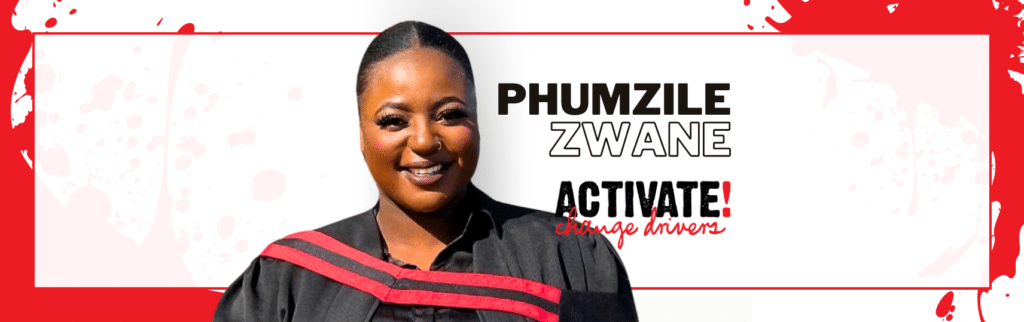
Phumzile “Phumi” Zwane is part of the Activate! Change Drivers Writing Hub, where she uses storytelling to spark dialogue on democracy, youth leadership, and social justice. Passionate about amplifying young voices and fostering inclusive change, she brings her background in marketing and communications into her writing blending.


Responses