
Should We Even Be Going to the Polls on the 4th? What’s the Point?


On 1 November 2021, while South Africans made their way to voting stations to elect their local government representatives, residents of Etwatwa, Ekurhuleni, were queuing for something else.
Water.
In the Barcelona section, outside Silindokuhle Primary School, buckets, wheelbarrows and makeshift water containers formed part of an election-day scene that should have troubled us all. For four days, taps in the community had run dry. Families needed water to cook, bathe and send their children to school. Voting could wait.
Speaking to the Sowetan that day, 70-year-old Maria Pitje, exhausted by years of service delivery failures, questioned why she should vote when nothing seemed to change.
Five years later, as South Africa prepares for another local government election on 4 November 2026, her frustration remains painfully familiar.
A tap that coughs out air. A pothole deep enough to swallow a tyre. The sour smell of sewage lingering outside someone’s gate. A young graduate sitting at home, refreshing an inbox that has delivered more rejection emails than opportunities.
And somewhere, on a lamppost overlooking it all, a smiling politician promises change.
Again.
So, should we even bother going to the polls on the 4th? What’s the point?
Perhaps we are not apathetic. Perhaps we are exhausted.
For years, young South Africans have been accused of political apathy. We are told we spend too much time on social media, complain endlessly about the country and fail to participate when it matters.
But perhaps we have been asking the wrong questions about young people’s relationship with democracy.
According to Statistics South Africa, youth unemployment among 15- to 34-year-olds reached 47.4% in the second quarter of 2026. That is almost one in every two economically active young people in this age group who wanted work but could not find it.
Imagine being told that your voice matters when your qualifications have been gathering dust for years. Imagine watching your parents stretch their social grants to keep the household afloat while political promises arrive with remarkable punctuality every election season.
In research published in July 2026, the Human Sciences Research Council (HSRC) challenged the familiar narrative of disengaged youth. Its findings suggest that many young people still value democracy but increasingly doubt that their votes translate into meaningful change.
Among Gen Z respondents, just 23% believed their vote made a difference in the 2024–2025 survey period.
And it is not only young people who feel politically homeless. An Ipsos survey found that 47% of South African adults felt no political party represented their views.
These are not simply numbers reflecting indifference. They reveal a crisis of confidence.
Young people are watching. They are listening. They are measuring political promises against the realities outside their front doors.
And increasingly, they are unconvinced.
But what exactly are we voting for?
Here is where the conversation becomes uncomfortable.
How many of us know the name of our ward councillor?
In September, YFM’s YNews interviewed 22-year-old first-time voter Malusi Buchingi, who called for regular ward meetings and greater accountability. He admitted that he could not identify his existing councillor.
He is unlikely to be alone.
On 4 November, South Africans will elect municipal councils and ward representatives. These are the people entrusted with decisions affecting water, sanitation, refuse collection, municipal roads, local electricity distribution, public spaces and municipal development priorities.
The pothole outside your house? The streetlight that has not worked for months? The rubbish collection truck that no longer comes?
These are not abstract political concerns. They are matters of local governance.
Of course, no ward councillor can single-handedly solve national unemployment or rebuild an entire economy. Nor can a ballot guarantee competent leadership.
But local government decisions influence the conditions in which communities live, businesses operate and opportunities emerge.
Perhaps the point of voting is not that it guarantees change, but that it gives us a say in who exercises power over decisions we live with every day.
That is a smaller promise than politicians often make. It is also a more honest one.
Democracy cannot end at the ballot box
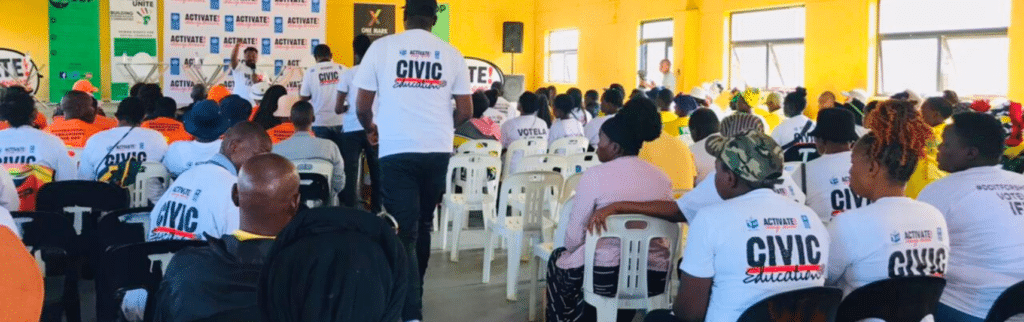
Across the ACTIVATE! Change Drivers network, young people are exploring what participation looks like beyond election day.
In October, the network reported that it had registered more than 100 election observers, conducted ten civic education activations across six provinces and supported the registration of nearly 500 first-time voters through its partnership with the Electoral Commission.
Some Activators are themselves contesting ward elections through different political formations or as independent candidates.
These activities do not guarantee better municipalities. But they offer examples of young people choosing different ways to engage with the democratic process: observing it, questioning it, participating in it and seeking representation within it.
ACTIVATE!’s executive programme director, Rammolotsi Sothaone, has emphasised that elections are only one part of democratic participation, encouraging young people to attend Integrated Development Plan meetings and contribute to decisions about their communities.
There is an important lesson here.
Democracy is not something that happens to us every five years. It is something we must continually interrogate, participate in and hold accountable.
It happens when residents demand explanations for unfinished projects, when communities examine municipal budgets, when young people attend ward meetings, and when elected representatives are expected to report back on their promises.
It happens when we refuse to mistake access to a politician for accountability.
And it happens when we recognise that meaningful participation cannot depend on having money, transport, political connections or the confidence to speak in a crowded public meeting.
So, what happens on the 4th?
If you are registered and considering voting, there are practical questions worth answering before election day.
Do you know who is contesting your ward? What have they done for your community? What are they promising, how will they fund those promises, and how will you measure their progress?
Check your registration details and designated voting station through the IEC. Remember that municipal elections require you to vote at the station where you are registered. The voters’ roll for this election closed on 7 August, so new registrations cannot be added for 4 November.
If you choose to vote, voting stations will be open from 07:00 to 21:00.
If you choose not to, that decision deserves reflection too. Withholding a vote may express genuine disillusionment, but it does not, by itself, determine who will govern your municipality or how they will be held accountable.
Neither voting nor abstaining automatically fixes a broken water pipe.
And whichever choice we make, the responsibilities of citizenship do not disappear when the results are announced.
Perhaps our biggest mistake has been expecting democracy to deliver change simply because we participated in an election, while accepting too little accountability in the years that follow.
Back in Etwatwa, residents were faced with two needs that should never have competed: the right to vote and the need for clean water.
Five years later, the question is no longer only whether young people will show up on 4 November.
It is whether the people who gain power will show up for their communities on 5 November, and on every ordinary day that follows.
Because a democracy worth believing in must give people more than the right to choose their leaders. It must also give them meaningful ways to demand answers when those leaders fail.
And perhaps that is where our next conversation should begin.
—————————————–
About the Author:
Ramadimetja Kekana is a freelance writer whose work explores social justice, mental health, education and youth development. Through human-centred storytelling and thought-provoking social commentary, she seeks to raise awareness, challenge prevailing narratives and deepen public understanding of the issues shaping people’s lives. Her writing places particular emphasis on amplifying underrepresented voices, examining systemic inequalities and bringing visibility to the experiences and challenges of marginalised communities. She believes in the power of storytelling to encourage critical reflection, meaningful dialogue and social change.


Responses